-
-
York Rite Kabbalah12 years ago
-
Bun Length Hotdogs17 years ago
Showing posts with label freemasonry. Show all posts
2008-03-08
RWW - This one's for you!
... and for the rest of those who have been wanting to hear from me again. Thank you all for your concern, your prayers, and your support. For better or for worse, I have found that blogging specifically to a Mormon audience is utterly not worthwhile. The Mormonism of today has its truth already, and is not looking for any innovation whatsoever. Innovation would separate it from mainstream Christianity, and favor with mainstream Christianity is that which the Saints of today most deeply covet. Strong words, perhaps, but true: If not individually, then collectively.
I am forever the heretic because I believe that Jehovah is the Father, as Joseph Smith did, and because I side with Brigham Young and Wilford Woodruff on certain issues which, according to Bruce R. McConkie, implies that I "have the intellect of an ant and the understanding of a clod of miry clay in a primordial swamp" and that I "do not deserve to be saved." Why won't "our" apologists apologize for statements such as this?
(Side note: 2,555,000,000 years old. Hmm.)
And yet I believe! Well, I believe in something, and my beliefs are deeply intertwined with Mormonism. They may not be the Orthodox religion, but they are Godly, or, if they are not, then I have been deceived. But, I choose to believe that the Holy Ghost I have felt is real, that the answers to prayer I received about Joseph Smith are true. But I am not part of mainstream Mormon culture. They look at me funny. I scare some of them. They just don't know how to deal with me. And the more I endure, the more sick I feel when I hear their teachings. I mean their pet teachings, their naive teachings, not the truth. When they preach the truth it is still sweet, but the other things, the naive assumptions and philosophies of some of their most prominent men which they have blended with the gospel offends my spirit in subtle ways, and I would rather be in an environment more facilitative of my spiritual growth.
Is this selfish of me? I'd like to help them grow. I'd like to pitch in and teach, but I can't. My teachings are not permitted. So I feel saddened by it all.
If you like my posts, my thoughts, and want to hear more from me, or speak with me, please consider reading and commenting on my Masonic blog: Lodgical. Nearly everything I write there and elsewhere has personal religious significance to me. Even the articles I write for other organizations. If you have comments or questions to share with me of an overtly Mormon nature, or just want to chat, please contact me directly by email at jeffREMOVE_THIS_PART@storago.com
I want to talk. I have very little religious fellowship now. I am currently accepted as a sort of sojourner ("on the path") in the Jewish community, but that is not a place to deeply discuss my Latter-day Saint beliefs.
Looking forward to hearing from you.
I am forever the heretic because I believe that Jehovah is the Father, as Joseph Smith did, and because I side with Brigham Young and Wilford Woodruff on certain issues which, according to Bruce R. McConkie, implies that I "have the intellect of an ant and the understanding of a clod of miry clay in a primordial swamp" and that I "do not deserve to be saved." Why won't "our" apologists apologize for statements such as this?
(Side note: 2,555,000,000 years old. Hmm.)
And yet I believe! Well, I believe in something, and my beliefs are deeply intertwined with Mormonism. They may not be the Orthodox religion, but they are Godly, or, if they are not, then I have been deceived. But, I choose to believe that the Holy Ghost I have felt is real, that the answers to prayer I received about Joseph Smith are true. But I am not part of mainstream Mormon culture. They look at me funny. I scare some of them. They just don't know how to deal with me. And the more I endure, the more sick I feel when I hear their teachings. I mean their pet teachings, their naive teachings, not the truth. When they preach the truth it is still sweet, but the other things, the naive assumptions and philosophies of some of their most prominent men which they have blended with the gospel offends my spirit in subtle ways, and I would rather be in an environment more facilitative of my spiritual growth.
Is this selfish of me? I'd like to help them grow. I'd like to pitch in and teach, but I can't. My teachings are not permitted. So I feel saddened by it all.
If you like my posts, my thoughts, and want to hear more from me, or speak with me, please consider reading and commenting on my Masonic blog: Lodgical. Nearly everything I write there and elsewhere has personal religious significance to me. Even the articles I write for other organizations. If you have comments or questions to share with me of an overtly Mormon nature, or just want to chat, please contact me directly by email at jeffREMOVE_THIS_PART@storago.com
I want to talk. I have very little religious fellowship now. I am currently accepted as a sort of sojourner ("on the path") in the Jewish community, but that is not a place to deeply discuss my Latter-day Saint beliefs.
Looking forward to hearing from you.
2007-04-06
In response to a post on "By Common Consent"
How to Give a Sacrament Meeting Talk - An Open Letter to Converts
This is in response to comment #44 on this above mentioned post, whose comments have been closed for some time: Ronan asked: "'Can someone tell me whether “talk” is an American-ism or a Mormon-ism in this context? Do business people or academics “give talks”?'
I can give the answer to this: This is one of hundreds of little administrational/organizational things that Mormonism has inherited from the rich heritage of Freemasonry. When a person is assigned to speak in a Masonic meeting it is termed a "Talk." We also have "Short Talks" which are talked designed to be 5 minutes or less, which has in modern times ultimately resulted in the widely circulated "Short Talk Bulletin" which I presume was originally used to provide a filler talk that can be used when one has not been prepared, but currently is just interesting in its own right.
The reason the Freemasons use the word "talk" is because of this: As Masonry is not a religion or a church, the statements cannot really be termed a Sermon, although talks may often involve biblical symbolism, etc.
This is in response to comment #44 on this above mentioned post, whose comments have been closed for some time: Ronan asked: "'Can someone tell me whether “talk” is an American-ism or a Mormon-ism in this context? Do business people or academics “give talks”?'
I can give the answer to this: This is one of hundreds of little administrational/organizational things that Mormonism has inherited from the rich heritage of Freemasonry. When a person is assigned to speak in a Masonic meeting it is termed a "Talk." We also have "Short Talks" which are talked designed to be 5 minutes or less, which has in modern times ultimately resulted in the widely circulated "Short Talk Bulletin" which I presume was originally used to provide a filler talk that can be used when one has not been prepared, but currently is just interesting in its own right.
The reason the Freemasons use the word "talk" is because of this: As Masonry is not a religion or a church, the statements cannot really be termed a Sermon, although talks may often involve biblical symbolism, etc.
2006-10-17
1 Nephi 17 - 22
I continued reading through the end of 1 Nephi.
I've been thinking about inspired work and foundations suitable for a testimony. The thought has occurred to me that books and other works can be inspired without being true. For example: The Chronicles of Narnia, The Lord of the Rings, The Wizard of Oz, Buffy the Vampire Slayer.
They can touch you and teach true principles and yet be fiction. I wonder about how The Book of Mormon can be considered distinct from this.
While studying, the thought crossed my mind that perhaps Joseph had the visions, the visitations, everything as he said and but was unable to translate the curious characters on the Golden Plates, desparately looking to his trusty seer stone to try to gain contact again with those heavenly forces that had started him on his mission. Knowing a little about the Nephite culture from his visitation by Moroni (or was it Nephi? - this has been a historical question as well since the story was told both ways), he attempted to produce the translation, but didn't even refer to the plates during the process -- all the while praying for revelation to guide him as it had done in the beginning. What if the Golden Plates never were translated, but an original inspired book was brought forth instead? This would account for Joseph's readiness to revise it and correct doctrine in it in subsequent years, and his tendency to disregard many of its clear teachings (on the monotheism, the trinity and polygamy for example) in later work. Had he known it was lacking he would be eager to correct its shortcomings, otherwise it seems he would have let it stand. I read somewhere a sentiment that suggested that Oliver Cowdery believed in the Golden Plates but had also indicated that they were never translated, nor ever intended to be. Please understand, this is all a "What if?" consideration.
If this were true, it would not invalidate Joseph Smith's mission. The keystone of our religion is a Masonic term the full meaning of which evades the understanding of the modern reader of the Book.
So, I have a lot of questions.
I've been thinking about inspired work and foundations suitable for a testimony. The thought has occurred to me that books and other works can be inspired without being true. For example: The Chronicles of Narnia, The Lord of the Rings, The Wizard of Oz, Buffy the Vampire Slayer.
They can touch you and teach true principles and yet be fiction. I wonder about how The Book of Mormon can be considered distinct from this.
While studying, the thought crossed my mind that perhaps Joseph had the visions, the visitations, everything as he said and but was unable to translate the curious characters on the Golden Plates, desparately looking to his trusty seer stone to try to gain contact again with those heavenly forces that had started him on his mission. Knowing a little about the Nephite culture from his visitation by Moroni (or was it Nephi? - this has been a historical question as well since the story was told both ways), he attempted to produce the translation, but didn't even refer to the plates during the process -- all the while praying for revelation to guide him as it had done in the beginning. What if the Golden Plates never were translated, but an original inspired book was brought forth instead? This would account for Joseph's readiness to revise it and correct doctrine in it in subsequent years, and his tendency to disregard many of its clear teachings (on the monotheism, the trinity and polygamy for example) in later work. Had he known it was lacking he would be eager to correct its shortcomings, otherwise it seems he would have let it stand. I read somewhere a sentiment that suggested that Oliver Cowdery believed in the Golden Plates but had also indicated that they were never translated, nor ever intended to be. Please understand, this is all a "What if?" consideration.
If this were true, it would not invalidate Joseph Smith's mission. The keystone of our religion is a Masonic term the full meaning of which evades the understanding of the modern reader of the Book.
So, I have a lot of questions.
2006-10-09
David O McKay
"Ours is the responsibility ... to proclaim the truth that each individual is ... entitled to freedom of thought, freedom of speech, freedom of assembly; that he has the right to worship God according to the dictates of his conscience. ... organizations or churches which deprive the individual of these inherent rights are not in harmony with God's will nor with his revealed word."Under President McKay, the Church approximately tripled the number of members and stakes (1.1 million to 2.8 million members, and 184 to 500 stakes)
--David O. McKay
President McKay spoke against communism due to its atheist underpinnings and the denial of freedom of choice inherent in such a system.
Here are a couple more important quotes from David O. McKay:
"If you will give your class a thought, even one new thought during your recitation period you will find that they will go away satisfied. But it is your obligation to be prepared to give that new thought" (1953)
And...
"True education seeks ... to make men and women not only good mathematicians, proficient linguists, profound scientists, or brilliant literary lights, but also honest men, combined with virtue, temperance, and brotherly love ... men and women who prize truth, justice, wisdom, benevolence, and self-control as the choicest acquisitions of a successful life" (1953)
President McKay was also instrumental in making the Temple rituals available to people in foreign languages, and in expanding and clarifying some portions of the Temple endowment.
According to Daniel W. Bachman, "David O. McKay, we learn, first explained the symbolism associated with the temple clothing by faithful Latter-day Saints."
Being a Freemason myself, I am familiar with several explanations of this symbolism, and for the benefit of those reading, I'd like to share the typical Masonic wording similar to what President McKay adopted, this being available openly on many Masonic websites (i.e. not considered part of the secret work):
The Square reminds us symbolically to square our actions, and the Compasses teach us to circumscribe our desires and keep our passions within due bounds toward all mankind.
The moral lessons associated with these emblems are deep and important, and what a blessing and demonstration of Divine Providence that the Latter-day Saints after going so many years without the majority of their men knowing the definition finally received a suitable one and removed some of the obscurity of these historic items.
2006-09-01
Freedom
I read this over at a Masonic Blog, and found it inspiring:
"Freedom dies under dogma. In a free society, no person or group or policy can be permitted to exist beyond scrutiny, criticism, even ridicule. When dogma gains enough power to punish those who oppose it, it becomes fanaticism. When dogma is invested with enough power to suppress opposition, it becomes tyranny. And when men are afraid to say what they think — however cockeyed or unpopular it may be – freedom has been violated, for it has been corrupted by fear."
I am proud to be a Mormon because our doctrine has such strong foundational principles relating to Freedom, especially Free Agency and religious freedom. For a religion to have support for religious freedom present at its core is very refreshing and makes a beautiful statement about its own security and self-confidence. I just hope we don't continue to lose sight of it!
"Freedom dies under dogma. In a free society, no person or group or policy can be permitted to exist beyond scrutiny, criticism, even ridicule. When dogma gains enough power to punish those who oppose it, it becomes fanaticism. When dogma is invested with enough power to suppress opposition, it becomes tyranny. And when men are afraid to say what they think — however cockeyed or unpopular it may be – freedom has been violated, for it has been corrupted by fear."
I am proud to be a Mormon because our doctrine has such strong foundational principles relating to Freedom, especially Free Agency and religious freedom. For a religion to have support for religious freedom present at its core is very refreshing and makes a beautiful statement about its own security and self-confidence. I just hope we don't continue to lose sight of it!
2006-08-07
The Temple Garment
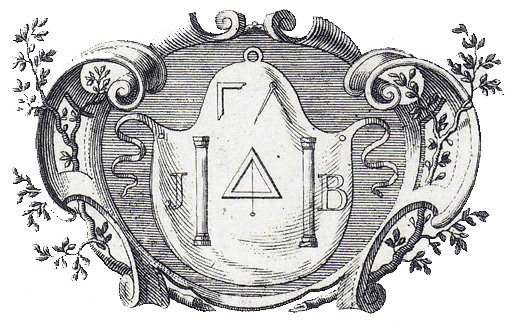
Nicholas's previous post gave me an interesting challenge: To write something on the subject of the Temple Garment. I present here, an old drawing of a Masonic apron. I am currently trying to find the history behind this picture, however, I want to point out a few things: The apron is replete with some "working tools", the Square, Compasses, and Level. Compared to the modern Fellow Craft who is taught that his working tools are the Square, Level, and Plumb. The Fellow Craft in some jurisdictions is taught that his Apron is made into a Pocket in which to hold his working tools, although I have never before seen this visualized. The garment and the apron indeed seem to have been synonymous at some point, perhaps having become that way as part of a gradual process. If the "flap" at the top of this apron were to be folded down, it appears you would be looking at the following:
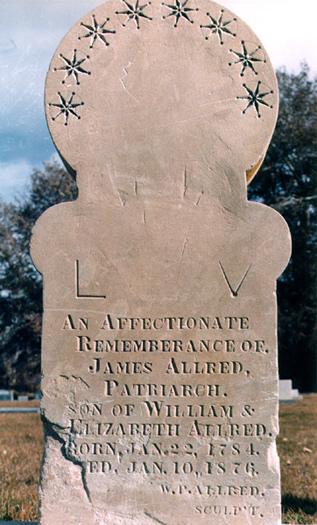
This would be the only time I have seen the symbols in a Masonic source oriented in the "L _ V" pattern. Fascinating. It is particularly intriguing that the locations of these working tools are over the correct side of the body, in comparison to the Temple Garment. However, the L is backwards of its ordinary position, giving some more credence to the antiquity of the layout used on the Allred gravestone. (see my earlier post on this reversal)
This also gives a possible answer for the two decorative tassle's often seen hanging down in older Aprons. Perhaps they are symbolizing Jachin and Boaz the two brazen pillars set up at the entrance of King Solomon's Temple? (Look up Antique Masonic Apron on eBay or somewhere to see photographs of these tassles, they were once quite prevalent especially in Grand Masters aprons, etc., during a not too distant past.)Well, maybe this answers something. But, now, returning to the Temple Garment... I have heard stories of the discovery of bodies buried by ancient tribes who have worn garments with markings or symbols on them. I have heard Hugh Nibley quoted as the source. I think I have even read it myself. I haven't seen any good photos, however, and so I wonder what types of markings these are. Certainly they are not too close to the current Temple Garment or else a bigger fuss would have been made over it. Nibley would have shown it, if the evidence was really so compelling. Instead, he merely referenced it as a similar curiosity.
We do get the following early Christian picture:

Hmmm, all squares, but no compasses or levels.
I don't know.
We have here, a drawing of the original garment, reported in 1882. I admit, it is probably not from the most reliable source. However, you will notice that the navel mark at this point was a round hole rather than another level/bar like that found on the knee. I have heard that the navel mark was traditionally either a round hole or an X, and that as it eventually become a sewn shut button hole, it took on the characteristic hyphen shape we have it in today.This is shown to demonstrate that the markings on the Garments of the Holy Priesthood can and do change, even over a short amount of time. I am interested to know what other permutations of symbolic garments have existed in Christian history, and in other traditions around the world. I would like to see some pictures or illustrations, if any exist.
And now for some scripture to show how this relates to the Old Testament Tabernacle of Moses:
Exodus 28:42-43
And thou shalt make them linen breeches to cover their nakedness; from the loins even unto the thighs they shall reach:
And they shall be upon Aaron, and upon his sons, when they come in unto the tabernacle of the congregation, or when they come near unto the altar to minister in the holy place; that they bear not iniquity, and die: it shall be a statute for ever unto him and his seed after him.
And,
Leviticus 16:4Hmm... So, the Linen Breeches seem to be the closest thing in the Tabernacle practices to the modern Garment.
He shall put on the holy linen coat, and he shall have the linen breeches upon his flesh, and shall be girded with a linen girdle, and with the linen mitre shall he be attired: these are holy garments; therefore shall he wash his flesh in water, and so put them on.
I have also heard stories about Adam's original garment, which was passed down through the generations of mankind. A legend or idea, which, along with some other Adamic hierlooms, is almost as amazing as the quest for the Holy Grail. Perhaps someone can fill in some details on this?
2006-07-27
The Emerald Temple - Part I
Note: This article is written from both the Mormon and Freemason perspective simultaneously, some parts may be applicable to one group of readers, and other parts to the other, while much of it will apply to both.
The Lion, The Tiger, The Bear. O My!
In looking at the Wizard of Oz, we will here examine both the book and the movie versions. If the symbolism contained within it is indeed a product of the collective unconscious, then we should consider it possible for the creators of the movie to have tapped into this same source to also create valid symbolism. We will, however, attempt to note the differences that exist between the two versions as they are presented here. This article will attempt to demonstrate significant parallels between this story and the LDS Temple Endowment, the symbolism of Freemasonry, and to the Ancient Israelite Tabernacle and Temple. I would welcome further comparisons to be introduced here, as there are probably numerous other tales and traditions that have been based upon these same archetypes.
The Farm in Kansas - Our First Estate - Condition of Darkness
In the book a storm was coming from the North and another from the South to form a Cyclone. Aunt Em went into the storm cellar. Dorothy was going to follow, but Toto ran and hid under the bed, so she went to get him. Halfway across the room, the house shook, "she lost her footing and sat down suddenly upon the floor." After this, the house rises into the air.
In the movie, Dorothy is returning home with Toto. She arrives and attempts to tell her Aunt and Uncle, and the farm hands, that Miss Gulch had whacked Toto with a rake. No one seems to be paying too much attention to her, and eventually Miss Gulch arrives to make complaint to the Gale family about the dog's misbehavior, and produces an order from the Sheriff to take Toto away and have him destroyed. Miss Gulch puts him in a basket and rides off on her bicycle, but Toto escapes, and returns to Dorothy's room through the window. Dorothy decides that she must run away before they come back to take him away from her. They go down a road, across a bridge, and come across Professor Marvel's wagon, proclaiming "Let him read your PAST, PRESENT and FUTURE in his Crystal," (also Juggling and Sleight of Hand). He has her close her eyes, as he takes a peek at the contents of her basket, and finds a picture of Aunt Em and the farm, and he proceeds to tell her what he 'sees in his Crystal' (the same genuine, magic, authentic crystal used by the Priests of Isis and Osiris in the days of the Pharaohs of Egypt), that Aunt Em is crying, and going to her room, dropping onto the bed with her hand on her heart. Dorothy decides she must go home right away, to which Marvel responds "I thought you were going along with me", and Dorothy and Toto depart. Back at the farm, we see the storm beginning to take its toll on the farm, as everyone hurries into the cellar. Aunt Em is calling for Dorothy, but Uncle Henry ushers her firmly into the cellar. Dorothy makes it into the house, the window of her room blows loose, hits her head, and she falls on the bed. After this, the house spins and rises into the air.
The Land of Oz

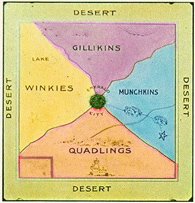
The Land of Oz is divided into four quarters, surrounded by a great desert, with the Emerald City at the center point. To the east is Munchkin Country, to the South is the Quadling Country, to the west is Winkie Country, and the North is the home of the Good Witch, details of this land are not specifically mentioned in the book, however we learn from later sources in the Oz series that it is Gillikin country.
Freemasons will be well acquainted with giving special significance to the South, West, and East, as well as a general silence given concerning the North, known as a "place of darkness" because in the Temple of Solomon, the Sun, being at the South at noonday, would not reach its rays into the Northern parts of the Temple. Masons may also note that the land of Dorothy's initiatory journey is Blue, as likewise the Three Degrees of Ancient Craft Masonry are sometimes referred to as "The Blue Lodge"
The color of Quadling Country to the South is Red, and it is home to the Palace of Glinda the Good. From other Oz material, we learn that the color of Winkie Country in the East is Yellow, and Gillikin country to the North is Purple.

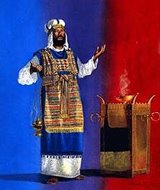
The four colors of the lands are the same as those worn on the sash of the High Priest in the Tabernacle of Moses: Scarlet, Blue, Purple, and Gold. At the center of which, is a city of Green, which happens to be the only distinctive color represented in the clothing worn by patrons of the Temples of the Latter-day Saints.
The York Rite of Masonry contains a similar progressive color scheme. The Symbolic "Blue Lodge" or Ancient Craft Masonry is commonly represented by Blue and Gold, The Chapter of Royal Arch Masons is Red, and The Council of Royal and Select Masters is Purple. Although Knights Templar is the usual body progressing beyond these, it is notably different in trappings from the preceeding bodies, and this authors believes it to be a newer innovation. Allied Masonic Degrees is an invitational body preserving additional and historical degrees, and green is its color. This is just one example of how these colors are applied in Freemasonry.
The Masonic lodge is said to have a Mosaic Pavement, emblematic of human life, checkered with good and evil. It is surrounded by a beautiful border called the "Indented Tessel", representing those blessings and comforts which surround us, and which we hope to obtain by a faithful reliance on Divine Providence which is hieroglyphically represented by the Blazing Star in the center. With the Wicked Witches in the East and West, and the Good Witches in the North and South, we have a checkered floor in the Land of Oz. It is surrounded by a great desert, and although it may not be called beautiful, it certainly would serve as a reminder of the blessings and comforts to be had inside the Land of Oz, by a faithful reliance on The Wizard of Oz, represented by the Emerald City in the center.
I would propose that Witches in the Wizard of Oz are representative of the Priesthood. One may note that all of the Witches are women. We will see more gender role reversals later in this study, and consider it at that time. The Church of Jesus Christ of Latter-day Saints has two priesthoods which can be used for Good: the Aaronic, and the Melchizedek. In the Temple, Satan appears to taunt Adam and Eve, and the patrons, and boasting, he gestures to his apron which he says represents his Power and Priesthoods. Priesthoods? Does this imply that these two priesthoods could be used for Evil, and perhaps already are being used in such a manner? Is this defiance of God's power be related to the unpardonable sin that causes Lucifer and his followers to become sons of perdition? On the other hand, he may be referring to entirely different priesthoods. Either way, a parallel is seen where two, be it Witchcrafts or Priesthoods, are for good, and the other two (or perhaps more, as Lucifer merely uses the plural) are for evil.
This concludes Part I of the Emerald Temple. The next part will be on the symbolic meanings of colors and characters in the Wizard of Oz.
The Lion, The Tiger, The Bear. O My!
In looking at the Wizard of Oz, we will here examine both the book and the movie versions. If the symbolism contained within it is indeed a product of the collective unconscious, then we should consider it possible for the creators of the movie to have tapped into this same source to also create valid symbolism. We will, however, attempt to note the differences that exist between the two versions as they are presented here. This article will attempt to demonstrate significant parallels between this story and the LDS Temple Endowment, the symbolism of Freemasonry, and to the Ancient Israelite Tabernacle and Temple. I would welcome further comparisons to be introduced here, as there are probably numerous other tales and traditions that have been based upon these same archetypes.
The Farm in Kansas - Our First Estate - Condition of Darkness
In the book a storm was coming from the North and another from the South to form a Cyclone. Aunt Em went into the storm cellar. Dorothy was going to follow, but Toto ran and hid under the bed, so she went to get him. Halfway across the room, the house shook, "she lost her footing and sat down suddenly upon the floor." After this, the house rises into the air.
In the movie, Dorothy is returning home with Toto. She arrives and attempts to tell her Aunt and Uncle, and the farm hands, that Miss Gulch had whacked Toto with a rake. No one seems to be paying too much attention to her, and eventually Miss Gulch arrives to make complaint to the Gale family about the dog's misbehavior, and produces an order from the Sheriff to take Toto away and have him destroyed. Miss Gulch puts him in a basket and rides off on her bicycle, but Toto escapes, and returns to Dorothy's room through the window. Dorothy decides that she must run away before they come back to take him away from her. They go down a road, across a bridge, and come across Professor Marvel's wagon, proclaiming "Let him read your PAST, PRESENT and FUTURE in his Crystal," (also Juggling and Sleight of Hand). He has her close her eyes, as he takes a peek at the contents of her basket, and finds a picture of Aunt Em and the farm, and he proceeds to tell her what he 'sees in his Crystal' (the same genuine, magic, authentic crystal used by the Priests of Isis and Osiris in the days of the Pharaohs of Egypt), that Aunt Em is crying, and going to her room, dropping onto the bed with her hand on her heart. Dorothy decides she must go home right away, to which Marvel responds "I thought you were going along with me", and Dorothy and Toto depart. Back at the farm, we see the storm beginning to take its toll on the farm, as everyone hurries into the cellar. Aunt Em is calling for Dorothy, but Uncle Henry ushers her firmly into the cellar. Dorothy makes it into the house, the window of her room blows loose, hits her head, and she falls on the bed. After this, the house spins and rises into the air.
The Land of Oz

The Land of Oz is divided into four quarters, surrounded by a great desert, with the Emerald City at the center point. To the east is Munchkin Country, to the South is the Quadling Country, to the west is Winkie Country, and the North is the home of the Good Witch, details of this land are not specifically mentioned in the book, however we learn from later sources in the Oz series that it is Gillikin country.
Freemasons will be well acquainted with giving special significance to the South, West, and East, as well as a general silence given concerning the North, known as a "place of darkness" because in the Temple of Solomon, the Sun, being at the South at noonday, would not reach its rays into the Northern parts of the Temple. Masons may also note that the land of Dorothy's initiatory journey is Blue, as likewise the Three Degrees of Ancient Craft Masonry are sometimes referred to as "The Blue Lodge"
The color of Quadling Country to the South is Red, and it is home to the Palace of Glinda the Good. From other Oz material, we learn that the color of Winkie Country in the East is Yellow, and Gillikin country to the North is Purple.
And the curious girdle of the ephod, which is upon it, shall be of the same, according to the work thereof; even of gold, of blue, and purple, and scarlet, and fine twined linen.
Exodus 28:8
Colors of the Clothing of the Priesthood

The four colors of the lands are the same as those worn on the sash of the High Priest in the Tabernacle of Moses: Scarlet, Blue, Purple, and Gold. At the center of which, is a city of Green, which happens to be the only distinctive color represented in the clothing worn by patrons of the Temples of the Latter-day Saints.And the eyes of them both were opened, and they knew that they were naked; and they sewed fig leaves together, and made themselves aprons.
Genesis 3:7
The York Rite of Masonry contains a similar progressive color scheme. The Symbolic "Blue Lodge" or Ancient Craft Masonry is commonly represented by Blue and Gold, The Chapter of Royal Arch Masons is Red, and The Council of Royal and Select Masters is Purple. Although Knights Templar is the usual body progressing beyond these, it is notably different in trappings from the preceeding bodies, and this authors believes it to be a newer innovation. Allied Masonic Degrees is an invitational body preserving additional and historical degrees, and green is its color. This is just one example of how these colors are applied in Freemasonry.
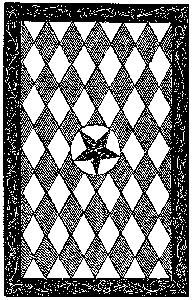
The Masonic lodge is said to have a Mosaic Pavement, emblematic of human life, checkered with good and evil. It is surrounded by a beautiful border called the "Indented Tessel", representing those blessings and comforts which surround us, and which we hope to obtain by a faithful reliance on Divine Providence which is hieroglyphically represented by the Blazing Star in the center. With the Wicked Witches in the East and West, and the Good Witches in the North and South, we have a checkered floor in the Land of Oz. It is surrounded by a great desert, and although it may not be called beautiful, it certainly would serve as a reminder of the blessings and comforts to be had inside the Land of Oz, by a faithful reliance on The Wizard of Oz, represented by the Emerald City in the center.I would propose that Witches in the Wizard of Oz are representative of the Priesthood. One may note that all of the Witches are women. We will see more gender role reversals later in this study, and consider it at that time. The Church of Jesus Christ of Latter-day Saints has two priesthoods which can be used for Good: the Aaronic, and the Melchizedek. In the Temple, Satan appears to taunt Adam and Eve, and the patrons, and boasting, he gestures to his apron which he says represents his Power and Priesthoods. Priesthoods? Does this imply that these two priesthoods could be used for Evil, and perhaps already are being used in such a manner? Is this defiance of God's power be related to the unpardonable sin that causes Lucifer and his followers to become sons of perdition? On the other hand, he may be referring to entirely different priesthoods. Either way, a parallel is seen where two, be it Witchcrafts or Priesthoods, are for good, and the other two (or perhaps more, as Lucifer merely uses the plural) are for evil.
This concludes Part I of the Emerald Temple. The next part will be on the symbolic meanings of colors and characters in the Wizard of Oz.
2006-07-19
Hinckley and the Freemasons - Same Divine Source?
This past month, President Gordon B. Hinckley had a beautiful message on the Godhead in the Ensign, which contained the statement:
Any Freemason would be familiar with the pairing up of these terms in the phrase:
Has the Prophet been reading up on his Masonry, is it a pure coincidence, or do Freemasonry and the Church share the same grand source of divine information? There are similar cases I have noticed in the contributions of President David O. McKay.
"I believe without equivocation or reservation in God the Eternal Father."
Any Freemason would be familiar with the pairing up of these terms in the phrase:
"... without the least equivocation, mental reservation, or secret evasion ..."
Has the Prophet been reading up on his Masonry, is it a pure coincidence, or do Freemasonry and the Church share the same grand source of divine information? There are similar cases I have noticed in the contributions of President David O. McKay.
2006-07-08
Origins of Masonry
I just posted on my other blog, King Solomon's Lodge, about the Origins of Masonry, and since any Latter-day Saint with a handle on Church history probably has some opinion or some curiosity as to the Masonic influence on the early church, I wanted to submit it here also for your benefit. Please try to keep LDS-centric comments in this blog post at Mormon Gnostics, rather than the original at KSL, so that the other thread can remain dedicated to its true topic, the Origins of Masonry, rather than the relationship of Masonry to Mormonism. For convenience, I have included the full text of the original post here:
The Origins of Masonry
Commonly held old legend says that Ancient Craft Masonry originated at the building of Solomon's Temple. Common scholarly opinion today refutes that, and suggests a much more recent origin for the Craft. I would like to put in my plug for the former opinion, to a degree. When was there ever a tradition, that was not taken from what went before it? Either directly, indirectly, or as a mirror image 'rebellion'. Truly, it seems, there is nothing new under the sun. I believe Masonry did come from Solomon's Temple, although it wasn't a direct Group => Group => Group lineage. I believe it was the merging of several traditions over a long period of time, where like-minded people banded together, and their traditions combined into something beautiful. I think there is good evidence to suggest that Freemasonry does have some origins, even in the mysteries of its secret work, clearly from the Temple of Solomon (or the Tabernacle of Moses) if someone opens their eyes enough to behold them. I do not believe it was the Stone Masons who formed the craft, however, but the Levites who worked in the Temple, or their direct observors, and their ideological descendents, coupled of course with the many other threads that pour into the river of Masonry by the time it hit England in the 1700's.
There are certain parts of Masonry that are pretty well determined to be modern additions. Modern in this sense, meaning anything around A.D. 1700 or later. The entire Legend of Hiram Abiff seems to be one of these things. However, I would like to suggest that because Masonry -- being the Handmaiden of religion - and a very religious group (although not a religion, note the disctinction) -- because Masonry has held true to these old customs and faithfully preserved things of God, they may have been blessed with further inspiration from Above. Either individually, or collectively, I believe Masonry's history has been divinely inspired and divinely approved. In many Jurisdictions, the Lodge is opened with a prayer containing something like this request:
"Grant that the sublime principles of Freemasonry may so subdue every discordant passion within us, so harmonize and enrich our hearts with Thine own love and goodness, that the Lodge, at this time, may humbly reflect that order and beauty which reign forever before Thy throne."
Could it be, that so many brethren, praying so unceasingly for their Lodge to reflect the GAOTU's own order and beauty, might actually be answered?
I say it might, and probably has, and probably will continue to be answered, if our prayers are sincere.
The Origins of Masonry
Commonly held old legend says that Ancient Craft Masonry originated at the building of Solomon's Temple. Common scholarly opinion today refutes that, and suggests a much more recent origin for the Craft. I would like to put in my plug for the former opinion, to a degree. When was there ever a tradition, that was not taken from what went before it? Either directly, indirectly, or as a mirror image 'rebellion'. Truly, it seems, there is nothing new under the sun. I believe Masonry did come from Solomon's Temple, although it wasn't a direct Group => Group => Group lineage. I believe it was the merging of several traditions over a long period of time, where like-minded people banded together, and their traditions combined into something beautiful. I think there is good evidence to suggest that Freemasonry does have some origins, even in the mysteries of its secret work, clearly from the Temple of Solomon (or the Tabernacle of Moses) if someone opens their eyes enough to behold them. I do not believe it was the Stone Masons who formed the craft, however, but the Levites who worked in the Temple, or their direct observors, and their ideological descendents, coupled of course with the many other threads that pour into the river of Masonry by the time it hit England in the 1700's.
There are certain parts of Masonry that are pretty well determined to be modern additions. Modern in this sense, meaning anything around A.D. 1700 or later. The entire Legend of Hiram Abiff seems to be one of these things. However, I would like to suggest that because Masonry -- being the Handmaiden of religion - and a very religious group (although not a religion, note the disctinction) -- because Masonry has held true to these old customs and faithfully preserved things of God, they may have been blessed with further inspiration from Above. Either individually, or collectively, I believe Masonry's history has been divinely inspired and divinely approved. In many Jurisdictions, the Lodge is opened with a prayer containing something like this request:
"Grant that the sublime principles of Freemasonry may so subdue every discordant passion within us, so harmonize and enrich our hearts with Thine own love and goodness, that the Lodge, at this time, may humbly reflect that order and beauty which reign forever before Thy throne."
Could it be, that so many brethren, praying so unceasingly for their Lodge to reflect the GAOTU's own order and beauty, might actually be answered?
I say it might, and probably has, and probably will continue to be answered, if our prayers are sincere.
2006-06-28
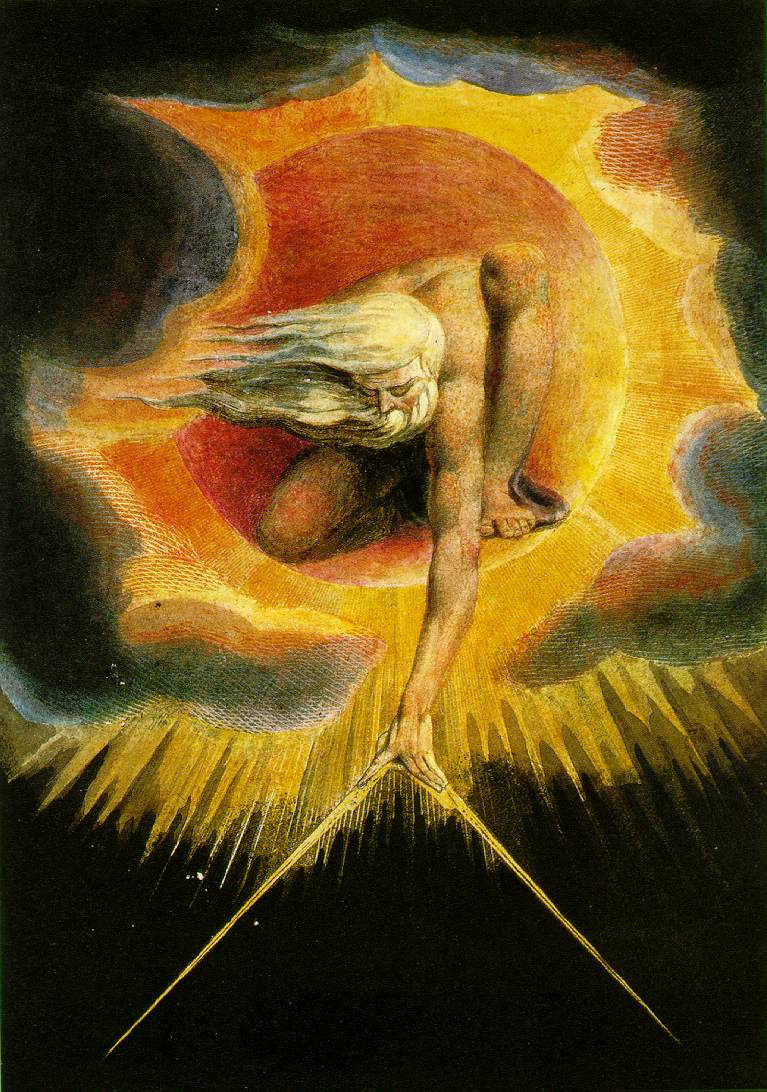
The Ancient of Days
Dated 1794, this 23.3 x 16.8 cm relief etching with watercolor by William Blake, is located at the British Museum in London.It is titled "The Ancient of Days" (one of the names of God, as properly understood by people of that time period.)
You'll notice He is depicted with a set of Compasses, with which he is inscribing the heavens (This was possibly a result of a Masonic influence, but I do not know.)
In Daniel chapter 7, the Ancient of Days opens the books of judgment and delivers all dominion and glory unto one like the Son of Man. We should recognize this prophecy for what it is actually depicting: Part of the process of Jesus Christ's exaltation, (with whom we get to be Joint Heirs, if we are true and faithful in all things). It is one of the most beautiful Old Testament prophecies foretelling the work of Jesus Christ.
2006-06-26
Reversed Square
I was browsing the web and found this picture, excerpted from the May 1985 Sunstone:

This is interesting, because it shows the Square and Compass in an orientation matching their use on the garment, and also demonstrates the antiquity of that specific orientation, as opposed to the Allred Gravestone, which some fundamentalists use to claim that we have reversed the orientation of the square today:

You'll notice that the Spring City Endowment House was constructed in the same year that James Allred died, thereby making these contemporary examples of usage. However, the tabernacle is obviously a more "official" edifice than a grave marker. Also, the TLC fundamentalist group seems to infer these symbols stand for Liberty and Virtue, and while I agree that they could represent these words, I think that it is mostly wishful thinking, as the symbols are far more antique than the roman alphabet. However, symbolically, these words are reversed, as Liberty, or freedom, is a female or creative idea, which should be connected with the V-shaped symbol, whereas Virtue, or "the square of virtue" as Masonry calls it, is a measure of "right" or morality, and is better represented by the masculine L-shape.

This is interesting, because it shows the Square and Compass in an orientation matching their use on the garment, and also demonstrates the antiquity of that specific orientation, as opposed to the Allred Gravestone, which some fundamentalists use to claim that we have reversed the orientation of the square today:

You'll notice that the Spring City Endowment House was constructed in the same year that James Allred died, thereby making these contemporary examples of usage. However, the tabernacle is obviously a more "official" edifice than a grave marker. Also, the TLC fundamentalist group seems to infer these symbols stand for Liberty and Virtue, and while I agree that they could represent these words, I think that it is mostly wishful thinking, as the symbols are far more antique than the roman alphabet. However, symbolically, these words are reversed, as Liberty, or freedom, is a female or creative idea, which should be connected with the V-shaped symbol, whereas Virtue, or "the square of virtue" as Masonry calls it, is a measure of "right" or morality, and is better represented by the masculine L-shape.
2006-06-24
Multiple Mortal Probations in the Blue Lodge
I often think of theology as it is mystically represented in the Masonic Lodge. We are craftsmen, at work in our labor. Joseph Smith sits in the South as the Junior Warden, Jesus Christ in the West as the Senior Warden, and Father sits in the East as the Worshipful Master. Upon consideration of this, I realized that it is the usual custom of a Lodge, each Masonic year (from St. John's day of one year, to the same on the next - or perhaps more meaningfully, on the Winter Solstice (the Darkest time of year), to have the officers of the Lodge advance up the line of "chairs", the old Junior Warden becoming the new Senior Warden, the old Senior Warden becoming the new Worshipful Master, and the old Worshipful Master becoming a "Past Master."
Could this be symbolic of progression from mortal to being "a Christ" to being "an Adam" of our own planet, and then eventually retiring amongst the wise Elohim?
To me, it is.
Could this be symbolic of progression from mortal to being "a Christ" to being "an Adam" of our own planet, and then eventually retiring amongst the wise Elohim?
To me, it is.
2006-06-23
Treasure Hunting
Yesterday I read a lot on the subject of treasure hunting, especially using "magic" methods such as dousing and using seer stones. Being a member of a Church whose history is steeped deeply in such practices, they are not something that can be dismissed with a shrug. I've been feeling an urge, or call of some type to return to the very roots of Mormonism, to start with the primitives from which the Restoration developed, and see what happens. I don't know exactly what that means. I've been considering doing a little treasure hunting myself, but I don't know if this is a metaphor or if I should break out the shovel. I have endeavored to spend some time attempting to use the seer stone technique, however, how to select the correct stone, I do not know. I have found a white marble stone that seems to have at least inspiration qualities to it, and using the hat technique, although I cannot see bright words, or any words, I have determined that the Holy Ghost whisper things to me, (and from my intricate theories about the third member of the Godhead, this seems to be a good use of the gift.)
Another way I have been seeking treasure is through Freemasonry, and I am about to take another big step in it by going through the Mark Master degree of York Rite, which will be on the 29th of this month - That's only a week away.
Although I haven't attained the level yet, the body above the Royal Arch Chapter is the Council of Cryptic Masons, and any brief definition of the system will say enough to make one realize that it involves exactly this type of story: Seeking a lost treasure, hid up in the earth. I wonder as I am advanced to that degree, if I will find it to be a prophecy that has already been fulfilled in Mormonism, in a way similar to that of Craft Degrees? I will have to read Joseph's account of acquiring the Book of Mormon plates and review all of his treasure hunting adventures as far as is possible in preparation of this rite so that I am fully able to draw comparisons. It also won't hurt to brush up on this part of history for the purpose of trying to go to the roots, the source of Mormonism and see what I can find. For, what better way to find out about something than go to the source of it?
So far, my theory is thus: Seer stones are useful for finding objects and translating. They solve static problems and puzzles, if you will, and function as a "magical" type item, in contrast to prayer which, when done in truth and in order, seeks the attainment of revelation directly from God and is more useful for finding inquiring to receive new information, special care, guidance, blessings.
Another way I have been seeking treasure is through Freemasonry, and I am about to take another big step in it by going through the Mark Master degree of York Rite, which will be on the 29th of this month - That's only a week away.
Although I haven't attained the level yet, the body above the Royal Arch Chapter is the Council of Cryptic Masons, and any brief definition of the system will say enough to make one realize that it involves exactly this type of story: Seeking a lost treasure, hid up in the earth. I wonder as I am advanced to that degree, if I will find it to be a prophecy that has already been fulfilled in Mormonism, in a way similar to that of Craft Degrees? I will have to read Joseph's account of acquiring the Book of Mormon plates and review all of his treasure hunting adventures as far as is possible in preparation of this rite so that I am fully able to draw comparisons. It also won't hurt to brush up on this part of history for the purpose of trying to go to the roots, the source of Mormonism and see what I can find. For, what better way to find out about something than go to the source of it?
So far, my theory is thus: Seer stones are useful for finding objects and translating. They solve static problems and puzzles, if you will, and function as a "magical" type item, in contrast to prayer which, when done in truth and in order, seeks the attainment of revelation directly from God and is more useful for finding inquiring to receive new information, special care, guidance, blessings.
2006-06-09
On the Highest Hills and in the Lowest Vales
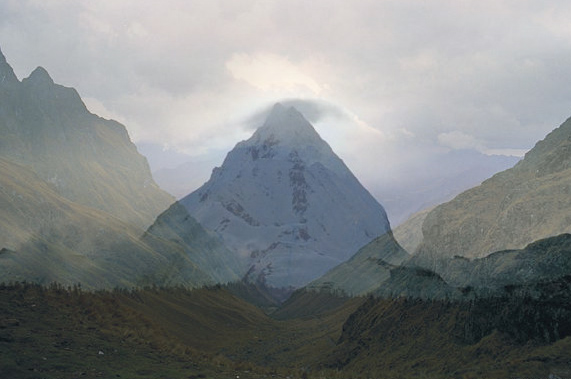
In Freemasonry, it is said that the ancient Brethren held their meetings "on the highest hills and in the lowest vales, the better to guard against the approach of cowans and eavesdroppers." Latter-day Saints also recognize these as natural temples: The valley of Adam-ondi-Ahman and the mount of transfiguration come to mind. Also, baptisms for the dead were by necessity performed in rivers, at the valley floor, before the Temple was completed, and mountain tops have long been held as places where it is possible for man to commune with God. A specially built temple provides a place where these two opportunities can exist within one building, at one location. Symbolically, it becomes both Mountain and Valley. Just for fun, I grabbed a picture of a mountain top and a valley and blended them. Here's what I came up with:

It looks very similar to the original spire on the Nauvoo Temple. Hmm.

It looks very similar to the original spire on the Nauvoo Temple. Hmm.
2006-05-28
Search for the best Joseph Smith Biography
This post is sort of a call for action. I am interested in opinions on where one can find the best, most definitive biography of Joseph Smith? I'm not interested in apologetics here, but the best detailed and frank exposition on the life of the Prophet? Whether web or printed publication, it would be nice to have something like this handy to point interested parties that direction.
It would be especially nice if it included things such as information from the Nauvoo Masonic Lodge minutes, and childhood information documenting Joseph's early reputation as a seer in a non-judging and simply informative way.
Subscribe to:
Posts (Atom)